
Custom Shirt Printing Quality Guide for Better Prints
Last Updated: November 2, 2026
Quick Summary
Custom shirt printing quality starts with choosing the right method for your fabric and order size: screen printing for bulk simple designs, DTG for small detailed runs, and DTF for mixed fabrics. Always approve a physical proof and run a wash test on the exact blank and ink before the bulk run.
- Screen printing bonds best with 100% cotton and suits bulk orders with simple, bold designs.
- DTG needs cotton to absorb water-based ink and works best for small runs and detailed designs.
- Run five home wash cycles and inspect prints at cycles 1, 3, and 5 against a baseline photo.
- Chest print placement commonly holds a tolerance of about 1/8 inch, measured from the collar and shoulder seams.
- K&M Print Works has no minimum order requirements and applies bulk discounts on orders of ten or more items.
Table of Contents
- Best T-Shirt Printing Methods and How They Compare
- Screen Printing vs. DTG: Which Fits Your Design and Order Size
- Custom Shirt Print Durability: Wash Resistance and Color Accuracy
- Custom Shirt Print Quality Checklist for Proof Approval
- Total Cost and Quality Trade-Offs Across Order Sizes
- Troubleshooting Print Problems by Symptom and Cause
- Ordering Custom Shirt Printing from K&M Print Works
- Frequently Asked Questions
Best T-Shirt Printing Methods and How They Compare
Custom shirt printing quality starts with the method, not the design. The printing method largely decides how a shirt looks on day one and how it holds up after repeated washes. Screen printing, direct-to-garment (DTG), direct-to-film (DTF), heat transfer, and sublimation each behave differently depending on fabric, design complexity, and order size. Here's how each performs so you can match it to your project.
| Method | Best Fabric | Best For | Durability | Setup Cost |
|---|---|---|---|---|
| Screen printing | 100% cotton, cotton blends | Bulk orders, simple bold designs | High | High per color |
| DTG | 100% cotton | Small runs, detailed designs | Moderate | Low |
| DTF | Cotton, polyester, blends | Mixed fabric orders | Moderate to high | Low |
| Heat transfer | Cotton, blends | Small runs, names and numbers | Moderate | Low |
| Sublimation | Polyester, light colors | All-over prints | High | Low |
Method-by-Fabric Compatibility
Fabric compatibility is the first filter. Screen printing bonds best with 100% cotton and cotton-heavy blends because plastisol ink sits on the surface and cures reliably. DTG needs cotton to absorb water-based ink; on polyester it can look washed out. DTF transfers adhere to cotton, polyester, and blends, making them the flexible option for mixed orders. Sublimation only works on polyester or specially coated light garments; on cotton, the dye has nothing to bond with.
Screen Printing vs. DTG: Which Fits Your Design and Order Size
Screen printing generally suits bulk orders with simple, bold designs, while DTG generally suits small runs and detailed designs. For a deeper comparison of screen printing against another common method, see our screen printing vs heat transfer guide. The trade-off is speed and cost at volume. If you're still deciding on quantities, our guide to custom t-shirt printing for small orders walks through the small-run options.
Design Preparation and Print-Ready Artwork
Print-ready artwork decides whether a design looks crisp or pixelated. Vector files (AI, EPS, PDF) scale cleanly for screen printing and DTF; raster files (PNG, JPG) need at least 300 DPI at final print size. Convert text to outlines, use spot colors where possible, and set the color mode correctly: CMYK for process printing, spot colors for screen printing. A common mistake is submitting a screenshot or compressed social media image, which looks fine on screen but blurs once printed at ten inches wide.
Custom Shirt Print Durability: Wash Resistance and Color Accuracy
Custom shirt print durability depends on ink type, cure temperature, and fabric, but "durable" is meaningless unless you can measure it. Instead of trusting a printer's adjective, run a repeatable test protocol on a sample before the bulk run. The checks below turn durability and color accuracy into pass/fail results you can compare across suppliers.
A Repeatable Wash-Test Protocol
Use one sample shirt per method and record results at each checkpoint:
- Baseline photo. Photograph the print flat under consistent daylight-balanced lighting at a fixed distance. This is your reference for fading and cracking.
- Wash cycles. Run five home wash cycles at the garment label's recommended setting, typically cold water, normal agitation, mild detergent, no fabric softener. Wash inside out.
- Dry cycles. Tumble dry low after each wash, or line dry if the care label specifies. High dryer heat is the leading cause of premature cracking, so keep the setting consistent.
- Inspect at cycles 1, 3, and 5. After each checkpoint, compare the print to the baseline photo and score it against the criteria below.
| Check | How to Test | Pass Criteria |
|---|---|---|
| Adhesion | Press a strip of clear packing tape across the print, smooth it down, and pull at a 45-degree angle | No ink lifts onto the tape |
| Cracking | Stretch the print area gently in both directions and inspect under bright light | No visible cracks along the ink film |
| Fading | Compare the washed print to the baseline photo under the same lighting | No obvious color shift or loss of opacity |
| Color consistency | Compare the washed sample to the approved proof | Shift stays within your agreed tolerance |
| Edge integrity | Inspect print borders at close range | Edges stay sharp with no fraying or bleed |
Measuring Color Accuracy Objectively
Color accuracy is a separate question from durability, and it's where subjective approval fails. Screen printing with Pantone-matched spot colors gives the tightest brand-color match because each ink is mixed to a reference.
To make color measurable, agree on a tolerance before production. A common industry approach is to express acceptable variation as a Delta-E value, the numerical distance between two colors, with a small Delta-E meaning the colors look nearly identical (Tolerancing with Quality Control Software for Color Accuracy).
What the Test Results Tell You
A failed adhesion check points to under-cured ink or a contaminated garment surface. Cracking after one or two washes usually means under-cured ink or too thick a deposit. Even fading across the print suggests a dye or ink that can't handle normal washing, while patchy fading often traces to an uneven cure. Record every result and keep the sample; it becomes the reference for acceptance criteria at proof approval and the evidence you need if a bulk run underperforms.
Custom Shirt Print Quality Checklist for Proof Approval
A proof is your last chance to catch problems before the full run prints, but vague visual checks only help if each item has a measurable pass/fail standard. The version below pairs every check with a concrete test and practical tolerance, so you and your printer agree on what "good" means before production starts.
The Measurable Proof-Approval Checklist
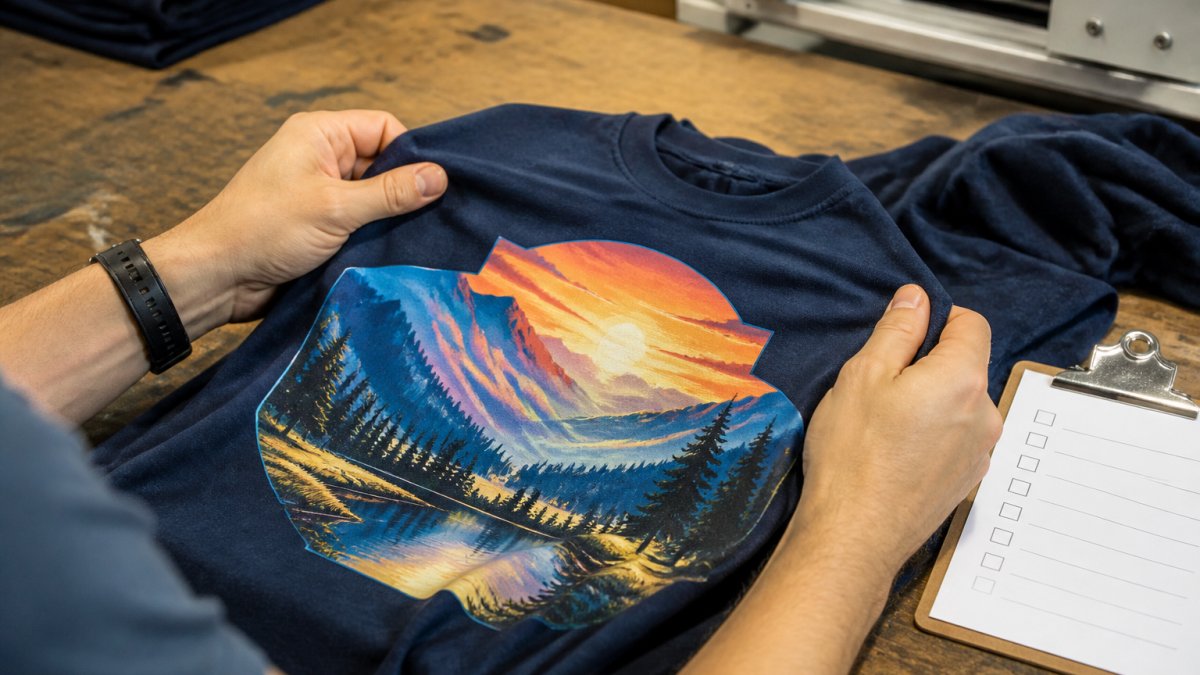
- Placement. Measure from the collar seam and both shoulder seams to the top corners of the print. Chest prints commonly hold a tolerance of about 1/8 inch; larger back prints allow slightly more because fabric shifts during loading. Confirm the print is level and centered within that tolerance.
- Dimensions. Measure print height and width against the approved spec. A common tolerance is plus or minus 1/8 inch on each dimension; anything larger is a reject.
- Color match. Compare the proof to your brand reference under daylight-balanced lighting. Agree on a Delta-E tolerance in writing, a small value means the colors look nearly identical, and confirm the printer will hold it between proof and run.
Writing Acceptance Criteria Before Production
A checklist is only enforceable if the tolerances are written into the order. Before you sign off, put the following in writing and have the printer confirm them:
| Criterion | What to Specify |
|---|---|
| Placement tolerance | Maximum offset in inches from the agreed center point, measured from seams |
| Dimension tolerance | Allowed variance in print height and width |
| Color tolerance | Agreed Delta-E range between proof and run |
| Adhesion standard | Tape-pull or stretch test must show no ink lift |
| Defect definition | What counts as a reject, misprints, off-register colors, ghosting, blurred edges |
| Remedy | Reprint, credit, or replacement for units outside tolerance |
This is the step most guides skip, and it's the one that prevents disputes after delivery. A printer who won't commit to written tolerances is telling you something about how the run will be judged.
Custom Short Sleeve T-Shirt – Personalized Print →
What to Do When a Proof Fails
If a proof misses tolerance, fix it before the run, not after. Placement and dimension misses are usually corrected by adjusting the setup or artwork file. Color misses may require a new ink mix or a different underbase on dark garments.
If you want to understand how the proofing process works before you sign off, our article on the custom apparel proofing process explains each stage.
Total Cost and Quality Trade-Offs Across Order Sizes
Cost per shirt falls as quantity rises, but only for methods with high setup costs. Screen printing rewards volume: the screens are a fixed cost, so a 200-shirt order spreads that cost thin. DTG and DTF have low setup, so their per-shirt cost stays flatter across quantities, making them the better choice for small runs. For a deeper look at volume pricing, our guide to bulk discount custom apparel pricing breaks down how order size affects cost and quality.
Troubleshooting Print Problems by Symptom and Cause
Most print defects trace to a specific, fixable cause. Cracking usually means under-cured ink or too much ink deposit; peeling points to poor adhesion or a contaminated garment surface. Fading after washing often comes from harsh detergent or high dryer heat. Ghosting and off-register colors on screen prints point to screen misalignment. Blurred edges on DTG suggest a clogged print head or wrong fabric pretreat.
Ordering Custom Shirt Printing from K&M Print Works
K&M Print Works keeps the process simple: no minimum order requirements, so a 15-shirt team order is welcome, and bulk discounts apply on orders of ten or more items. We ship nationwide from Ohio, and every order includes a proof before production so you can approve placement, color, and size before we print. Our custom short sleeve t-shirt is a soft, breathable cotton shirt with a unisex fit that suits personalized gifts, team shirts, and business branding.

Frequently Asked Questions
How can you tell if a custom shirt print is high quality?
Check four things: ink adhesion (no cracking or peeling at the edges), color accuracy against your approved proof, print resolution (fine lines and small text stay sharp, no pixelation), and soft hand feel that matches the method you chose. Run a wash test on a sample shirt before bulk production, and inspect seams, hems, and print placement. A print that passes all four holds up through repeated wear and washing.
Which custom shirt printing method lasts the longest?
Durability depends on the printing method, the fabric, and how the garment is cared for. DTF and heat transfer can match that durability when applied correctly, but adhesion depends on fabric type and press settings. DTG holds well on 100% cotton but can fade faster on polyester blends. Match the method to the fabric and follow care instructions for the best result.
What is the difference between screen printing and direct-to-garment printing?
Screen printing pushes ink through a mesh screen, one screen per color, so setup costs are higher but cost per shirt drops fast on bulk orders. It delivers thick, vibrant ink on simple designs. DTG printing works like an inkjet printer directly on the garment, with no setup cost and full-color detail, which suits small runs and detailed artwork. DTG ink sits on the surface and can feel softer but may fade sooner on blends.
How do you choose the right shirt fabric for custom printing?
Match the fabric to the method. Screen printing performs best on 100% cotton and cotton-rich blends. DTG needs high cotton content for vibrant color and wash resistance. DTF and heat transfer bond well to polyester and blends, which makes them a fit for performance wear and jerseys. Always request a sample shirt on the exact blank you plan to order, because the same design can look different on cotton, polyester, and tri-blend garments.
What file format and resolution should artwork be for shirt printing?
Send vector files (AI, EPS, SVG, or PDF) when possible, since they scale without losing quality. For raster artwork, supply at least 300 DPI at the final print size, in the correct color mode (CMYK or spot colors for screen printing, RGB for DTG). Avoid JPEGs pulled from websites, which pixelate when enlarged. Name files clearly and confirm print placement and dimensions before proof approval.
How should you wash a custom printed shirt to prevent fading or cracking?
Turn the shirt inside out, wash in cold water on a gentle cycle, and use mild detergent. Skip fabric softener and bleach, which break down ink and fibers. Tumble dry low or hang dry, and never iron directly over the print. Following these care instructions protects print durability and keeps colors accurate far longer than standard washing.
What should you check before approving a custom shirt order?
Review the proof for color accuracy, spelling, print size, and placement on the garment. Confirm the blank shirt style, fabric, and color match what you ordered. Ask for a sample shirt on the exact blank if the order is large. Check production tolerances (small shifts in placement and color are normal), confirm the delivery date, and keep a copy of the approved proof so any mismatch can be resolved quickly.
Do small orders get the same print quality as bulk orders?
Print quality should not depend on order size, but the method may change. At K&M Print Works, there are no minimum order requirements and bulk discounts apply on orders of 10 or more items.
Getting a print that still looks sharp after a season of washes comes down to choosing the right method for your fabric and order size, then approving a proof with clear acceptance criteria. K&M Print Works handles that for you with no minimums, bulk discounts on orders of ten or more items, and a proof step before every run. Get started with K&M Print Works and order custom shirts that hold their color and fit your team.
