
Screen Printing vs Heat Transfer for Team Shirts: 2026 Guide
Last Updated: October 23, 2026
Quick Summary
Screen printing vs heat transfer for team shirts comes down to quantity and design complexity: screen printing wins on large runs of simple, bold artwork, while heat transfer wins on small batches, personalization, and full-color designs. Count the shirts, then count the colors, high quantity with low color count means screen printing, low quantity or high color count means heat transfer.
- Screen printing charges setup per screen, per color, while heat transfer has minimal setup cost.
- If your design has more than three colors and you're ordering under 50 pieces, HTV or DTF almost always beats screen printing on total cost.
- Screen printing wins clearly on large runs of 100+ shirts with 1-3 colors as setup spreads thin.
- For personalized names and numbers, heat transfer and DTF beat screen printing because variation is cheap.
- A hybrid order can screen print the team logo, then add names and numbers with heat transfer or DTF.
Table of Contents
- Screen Printing vs Heat Transfer for Team Shirts: The Core Trade-Offs
- Screen Printing vs Heat Press: Key Differences That Affect Your Order
- HTV vs Screen Printing: Which Fits Your Design and Quantity?
- Screen Printing vs DTF for Shirts: Where DTF Fits In
- Cost Per Shirt and Setup Costs: Side-by-Side Examples
- Durability, Wash Performance, and How to Wash Printed Team Shirts
- Personalized Names and Numbers: Which Method Works Best?
- Which Method Should You Pick for Your Team Order?
- Frequently Asked Questions
Screen Printing vs Heat Transfer for Team Shirts: The Core Trade-Offs
The choice between screen printing vs heat transfer for team shirts comes down to one question: how many shirts, and how complex is the design? Screen printing wins on large runs of simple, bold artwork.
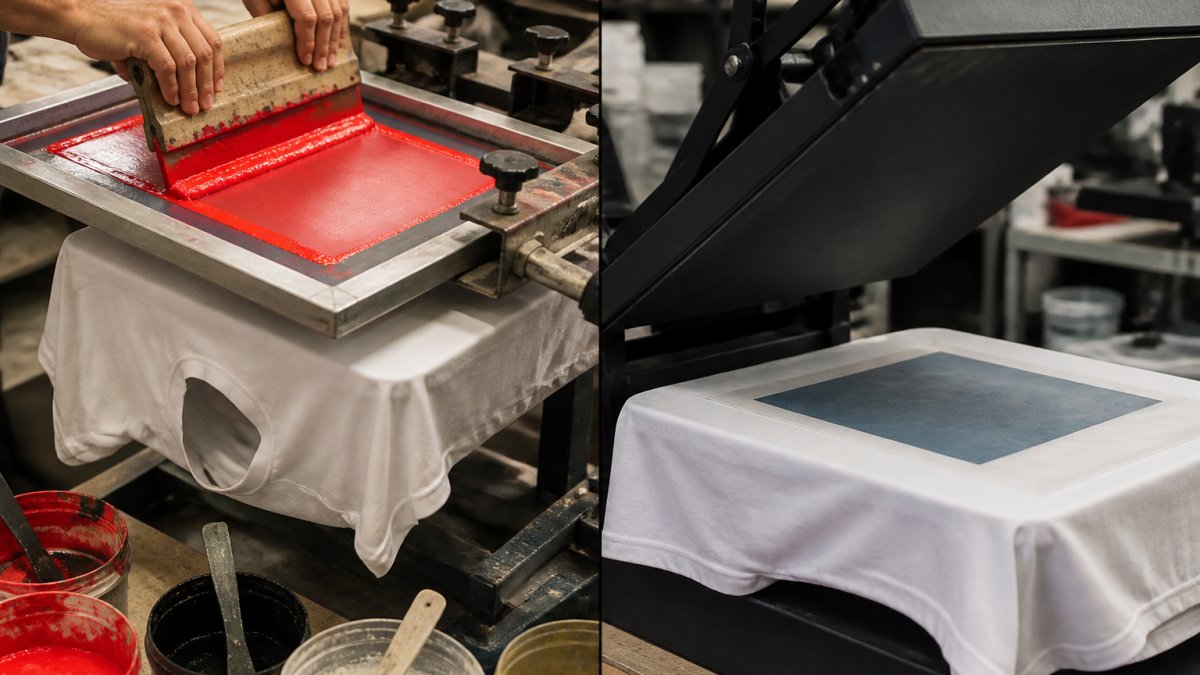
Screen printing is a production method where ink is pushed through a fine mesh screen onto fabric, one screen per color. Both produce durable custom apparel.
How Screen Printing Works
Ink passes through a stenciled mesh screen and bonds directly into the fabric. Each color needs its own screen, so setup labor rises with color count. The payoff: on large runs, per-shirt cost drops fast because the setup is spread across hundreds of pieces. Screen printing handles bold, simple designs with limited colors best.
How Heat Transfer Works
A design is printed onto transfer paper or film, then applied with a heat press. There's no screen setup, so small batches and one-off personalization stay affordable. Full-color artwork, photos, and gradients reproduce well. The trade-off is that transfer feel and wash life vary more by material quality than screen printing does.
Screen Printing vs Heat Press: Key Differences That Affect Your Order
The practical differences between screen printing vs heat press show up in setup cost, turnaround time, and how each handles color. Screen printing carries a per-color setup cost but rewards volume. Heat press has near-zero setup and suits short runs.
| Factor | Screen Printing | Heat Transfer |
|---|---|---|
| Setup cost | Per screen, per color | Minimal |
| Best order size | Large runs | Small batches to mid runs |
| Color count | Limited colors, cheaper | Full color, no penalty |
| Names and numbers | Awkward, costly | Easy, one-off friendly |
| Surface feel | Ink in fabric | Sits on fabric |
| Wash durability | Excellent on cotton | Good to excellent by quality |
Turnaround time differs too. Screen printing needs screens burned and registered before the run starts. Heat press moves faster on small jobs because there's no screen prep.
HTV vs Screen Printing: Which Fits Your Design and Quantity?
HTV vs screen printing is really a question of design complexity against quantity. HTV (heat transfer vinyl) is cut and pressed per piece, so it shines on small batches, single-color logos, and names or numbers. Screen printing shines when you need hundreds of identical shirts.
For team shirts, a common mistake is ordering screen printing for a 12-person roster with individual names. That drives up setup and slows production. HTV handles the personalization without a screen for every variation.
Screen Printing vs DTF for Shirts: Where DTF Fits In
Screen printing vs DTF for shirts comes down to color and detail. DTF (direct-to-film) prints full-color artwork onto film, then heat-presses it onto the garment.
DTF sits between the two classics. It gives you heat transfer flexibility with print quality that rivals screen printing on detailed artwork. The catch is surface feel: DTF sits on top of the fabric, so very large solid-color prints can feel heavier than screen-printed ink.
Cost Per Shirt and Setup Costs: Side-by-Side Examples
Cost per shirt falls as quantity rises with screen printing, while heat transfer stays flatter.
A useful way to model it is to separate the three cost buckets:
- Garment cost: The blank shirt itself. This is roughly the same regardless of decoration method, though some fabrics (performance polyesters, ringspun cotton) cost more than basic cotton tees.
- Setup cost: Screen charges per color for screen printing; artwork prep and film/vinyl cutting for heat transfer. Setup is a one-time cost per design, not per shirt.
- Per-shirt decoration cost: Ink, labor, and press time for each piece. This is where screen printing's volume advantage compounds.
Here is how the math shifts across common team order sizes.
Small batch (6-15 shirts, 1-2 colors): Heat transfer wins on total cost. With screen printing, two screens might add $40-$60 in setup before the first shirt is printed, and that setup is spread across only a dozen pieces. Heat transfer vinyl or DTF has minimal setup, so the all-in cost stays close to garment plus a modest per-piece decoration charge.
Small batch (6-15 shirts, 4+ colors): Heat transfer wins even more clearly. Screen printing would require four or more screens, pushing setup past the cost of the shirts themselves.
Mid run (25-50 shirts, 1-3 colors): The methods converge. Screen printing's setup is now spread across enough pieces that its lower per-shirt decoration cost starts to offset the upfront charge. Simple designs favor screen printing; complex, full-color designs still favor DTF because screen printing would need a screen per color.
Large run (100+ shirts, 1-3 colors): Screen printing wins clearly. Setup spreads thin, and per-shirt decoration cost drops to its lowest point. The more shirts you add, the wider the gap grows.
Large run (100+ shirts, 4+ colors): Screen printing still usually wins, but the margin narrows because each additional screen adds setup.
Bulk packages make this concrete. Our Starter Bundle covers 6 shirts and 2 hats for $99, ideal for small teams. The Team Essential delivers 15 shirts and 6 hats for $252, and the Premium Bulk scales to 40 shirts and 15 hats for $643 for high-volume orders.


One more cost driver specific to teams: roster changes. If you order 20 shirts and three players join later, screen printing a second small run means paying setup again. Heat transfer lets you add a few pieces without re-paying screen charges, which is why coaches managing mid-season additions often prefer it even when the initial order was screen printed.
Durability, Wash Performance, and How to Wash Printed Team Shirts
Properly cured prints hold up for the life of the garment, but how you wash printed team shirts decides whether they last.
- Turn shirts inside out before washing
- Wash cold on a gentle cycle
- Skip fabric softener and bleach
Screen-printed ink bonds into the fabric and resists cracking well. Heat transfer prints can peel or crack if washed hot or dried on high heat. The difference in lifespan often comes down to care, not the method itself.
Personalized Names and Numbers: Which Method Works Best?
For personalized names and numbers, heat transfer and DTF beat screen printing. The reason is mechanical: screen printing requires a separate screen for every unique element.
How the two personalization paths actually work:
- Heat transfer vinyl (HTV): Individual letters and numbers are cut from colored vinyl film, then pressed onto the garment one piece at a time. This is the traditional approach for jersey names and numbers. It handles single-color elements well and produces a crisp, durable result on cotton and polyester. The trade-off is labor: many small pieces mean more press time per shirt, which shows up as a per-piece charge rather than a setup charge.
- DTF (direct-to-film): The entire name-and-number layout is printed as one full-color film, then pressed in a single step. This is faster per shirt and handles multi-color or gradient numbers without extra cost. It sits on top of the fabric, so feel is slightly heavier than HTV on large solid areas.
Either way, the pricing structure is what matters for a team order.
This is where team-specific ordering gets practical. A coach ordering 20 jerseys with different names and numbers is a heat transfer or DTF job, not screen printing.
One practical note on placement: names and numbers are usually pressed after the main design is applied, so confirm the print order with your shop. Pressing a name over an already-cured screen print can affect adhesion, and a shop that runs both methods daily will know how to sequence the steps.
Which Method Should You Pick for Your Team Order?
Pick screen printing for large runs of simple, limited-color designs. Pick heat transfer, HTV, or DTF for small batches, full-color artwork, and personalized names and numbers. When in doubt, match the method to your quantity first, then your design.
At K&M Print Works, we offer both methods with no minimum order requirements and bulk discounts on orders of 10 or more items, shipping nationwide. Our Growth Package gives you 10 shirts and 4 hats for $171, a practical starting point for growing teams.

Frequently Asked Questions
Which lasts longer on team shirts, screen printing or heat transfer?
Screen printing typically outlasts heat transfer because the ink bonds directly into the fabric rather than sitting on top as a layer. With proper care, screen-printed team shirts can hold up through 50 or more washes without cracking or peeling. Heat transfer prints, especially those using vinyl (HTV), tend to show wear sooner, often around 20 to 30 washes. The gap widens with frequent washing and high heat. For teams that wear shirts weekly, screen printing is the more durable choice.
Is screen printing or heat transfer more cost-effective for a team order?
For larger team orders, screen printing usually wins on cost per shirt. Setup costs are higher because each color requires a separate screen, but that cost spreads across the whole run. Heat transfer has lower setup and makes sense for small batches or single shirts. If you are ordering 15 or more shirts with a simple design, screen printing often lands at a lower per-shirt price. For fewer than 10 shirts, heat transfer is typically more affordable.
Can screen printing handle multicolor team logos?
Yes, screen printing handles multicolor logos well, but each color adds a screen and a setup charge. A three-color logo means three screens, which raises the initial cost. For team shirts with bold, simple designs in two or three colors, screen printing delivers vibrant, long-lasting results. If your logo has gradients or many colors, heat transfer or DTF may be more practical because they can print full-color designs without per-color setup fees.
Which printing method works better for names and numbers on team shirts?
Heat transfer is often the better fit for personalized names and numbers. Each player's name and number is unique, so heat transfer lets you produce individual pieces without the per-color setup that screen printing requires. Screen printing can handle names and numbers, but the cost climbs because every variation needs its own screen. For teams where personalization is a priority, heat transfer keeps the process simpler and more budget-friendly, especially on smaller rosters.
How should you wash printed team shirts to help them last?
Turn printed team shirts inside out and wash them in cold water on a gentle cycle. Avoid fabric softener and bleach, which break down inks and adhesives. Tumble dry on low or hang dry; high heat is the main cause of cracking and peeling. Skip ironing directly on the print. Following these steps helps screen-printed and heat transfer shirts alike last longer, though screen printing generally tolerates more wash cycles before showing wear.
Choosing the right print method for your team shouldn't mean guessing at setup costs or settling for a method that doesn't fit your order. K&M Print Works handles both screen printing and heat transfer with no minimums, bulk discounts on orders of 10 or more, and nationwide shipping from Ohio. Get started with K&M Print Works and order team shirts that look sharp and hold up wash after wash.
