
What Does the Custom Apparel Proofing Process Involve?
Last Updated: November 1, 2026
Quick Summary
Apparel proofing involves reviewing a preview of your final printed design that shows layout, print size, placement, and an approximate color before production begins. You check text, artwork, sizing, and garment colors, then give written approval that locks the design for printing.
- A proof shows placement, size, and layout but not exact ink tone or print feel.
- Digital proofs arrive faster, while physical samples show real ink on real fabric.
- Read text aloud and backward to catch spelling and number errors.
- Ask to see proofs scaled across your smallest and largest sizes.
- Nothing goes to production without your written approval of a tracked proof version.
Table of Contents
- Why the Proof Is the Step That Decides Your Whole Order
- What a Custom T-Shirt Design Proof Can and Cannot Show You
- Color Accuracy: Why the Screen Lies and the Shirt Doesn't
- Your Apparel Proof Approval Checklist Before You Say Yes
- Revisions, Written Approval, and Who Owns the Final Call
- How Proofing Fits Into the Custom Apparel Order Timeline
- Start Your Proof With a Package That Fits Your Group
- Frequently Asked Questions
Why the Proof Is the Step That Decides Your Whole Order
The custom apparel proofing process explained here starts with one hard truth: the proof is where your order is won or lost. Get it wrong, and you approve a mistake that gets printed on every shirt in the box. That is why proofing should be treated as the decision point, not a formality. A proof is a preview of your final printed apparel, showing design placement, size, and color before production begins. Below, we walk through exactly what to check, what a proof can and cannot show, and who signs off.
What a Custom T-Shirt Design Proof Can and Cannot Show You
A custom t-shirt design proof shows layout, print size, placement, and a close approximation of color. It cannot show the exact ink tone on fabric, the feel of the print, or how the design ages after washing. To understand how the print method itself shapes what a proof can represent, compare screen printing vs heat transfer for team shirts. Think of it as a map, not the territory.
Digital Proofs vs. Physical Samples
Digital proofs generally arrive faster than physical samples, which show real ink on real fabric.
| Proof Type | What It Shows Well | What It Misses | Best For |
|---|---|---|---|
| Digital proof | Placement, size, layout | Exact ink color, print feel | Simple designs, small runs |
| Physical sample | Real ink on real fabric, texture | Full production scale | Bulk orders, color-critical work |
Color Accuracy: Why the Screen Lies and the Shirt Doesn't
Your monitor glows. Fabric does not. A color that looks vivid on screen can print duller on a dark shirt, and light inks on dark garments often need a base layer to show true. That is not a flaw in the proof; it is how ink and cloth behave.
Here is what to expect:
- Screens display light; fabric reflects it, so tones shift.
- Dark garments can mute bright inks without a base coat.
- Exact color matching across a large run is an approximation, not a guarantee.
If a specific color matters, say so before proofing and ask how it will print on your chosen fabric.
Your Apparel Proof Approval Checklist Before You Say Yes
Run this checklist every time before you approve. The goal is not to admire the design, but to verify the details that are expensive to fix after the press starts.
The Pre-Approval Verification Checklist
Text and content
- Spelling, punctuation, and numbers are correct on every line, read it aloud, then read it backward.
- Names, dates, scores, and URLs match the source you provided.
- Trademark and licensing symbols (®, ™, ©) are present where required.
- No placeholder text, stray marks, or missing elements.
Artwork and file integrity
- The logo is the correct version (not an old mark, not a low-resolution copy).
- The design is not stretched, squashed, or cropped.
- Fine lines and small text are thick enough to print, thin strokes and tiny serifs can fill in or disappear.
- Backgrounds are transparent where they should be; no unintended white box around the art.
Size and placement
- Print dimensions match what you ordered (width and height, in inches).
- Placement sits where you want it, chest, back, sleeve, pocket, hem, and is centered on the garment, not just on the screen.
- The design clears seams, collars, zippers, and pockets.
- Left-chest and full-back placements are shown at the correct scale relative to the garment.
Color and garment
- Colors look right for the garment shade, and you have noted any color that must match a brand or team standard.
- Every garment color in the order is shown separately, the same ink reads differently on white, navy, and gray.
Order scope
- Every size in the order is represented, and the design is scaled appropriately for each.
- Quantities per size and per color match your order form.
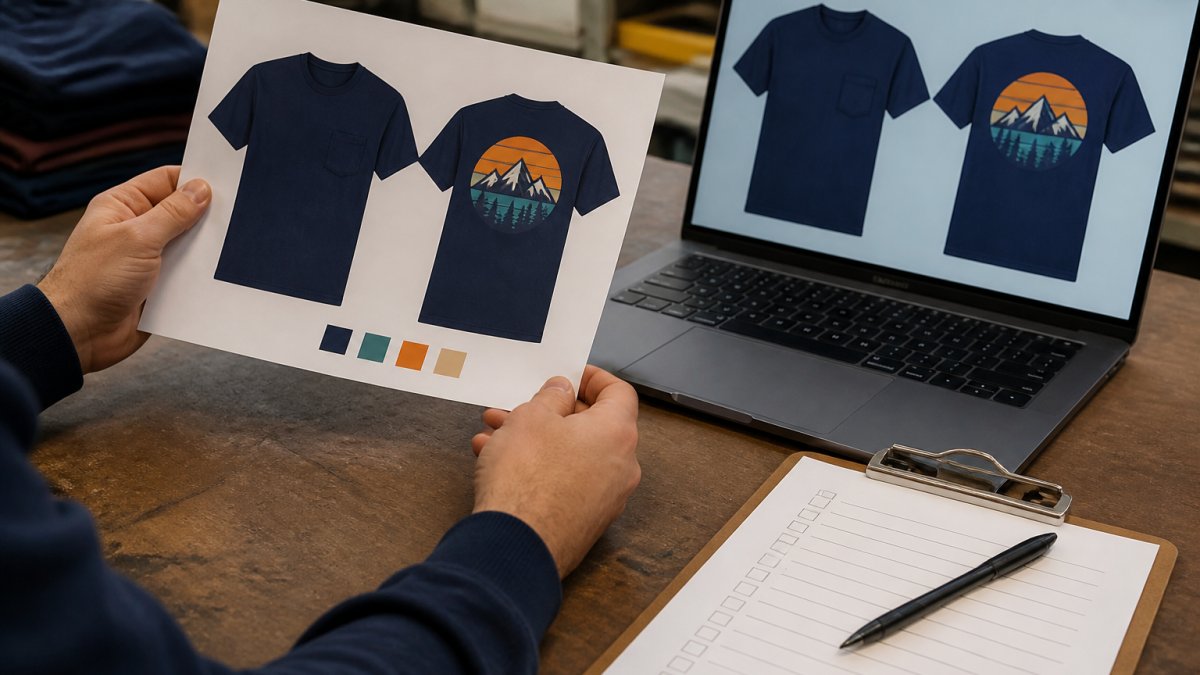
One missed letter on a proof becomes one missed letter on hundreds of shirts. Slow down here.
Proofing Across Sizes, Garment Colors, and Print Locations
A design that looks right on a medium chest can crowd a small or float on a 3XL. Ask to see the proof scaled across your size range, at minimum the smallest and largest sizes in the order. Check each garment color separately, since the same ink reads differently on white, navy, and gray. If the order includes multiple print locations (front, back, sleeve), confirm each location is proofed at its own scale and position, not copied from the front. If you are proofing a small or mixed-size run, our guide to custom apparel with no minimum order explains how flexible quantities affect your garment and size choices.
Revision Rounds, Written Approval, and Change Control
Revisions are normal, and most proofs need at least one. The rule that protects you is simple: nothing goes to production without your written approval. That approval is the change-control line. Once you sign off, the design is locked.
A few mechanics make that line real:
- **Ask how many revision rounds are included, and know the number before you start.
- Approve in writing, not verbally. A reply that says "approved" with the proof version attached is the cleanest record. Verbal approvals and hallway sign-offs leave you owning the result if a typo prints.
- Track the version. Reference the proof version number or date in your approval so there is no ambiguity about which file was locked.
- Understand the cost of changes after approval. Changes made after sign-off, even small ones, can require new screens, new setup, and a production delay, and are often billed as a new setup rather than a revision.
Who owns the final call? You do. We can flag a risk, but the approval is yours. The shop's job is to show you an accurate proof and answer your questions; your job is to verify the details and sign off on the version you actually reviewed.
Revisions, Written Approval, and Who Owns the Final Call
Revisions are normal, and most proofs need at least one. The rule that protects you is simple: nothing goes to production without your written approval. That approval is the change-control line. Once you sign off, the design is locked.
Who owns the final call? You do. We can flag a risk, but the approval is yours. Watch out: approving verbally or in a rush, then spotting a typo after printing, leaves you owning the result. Get it in writing, and read it once more before you send it.
How Proofing Fits Into the Custom Apparel Order Timeline
The faster you review and approve, the sooner your order can move forward. See how proof approval fits into the custom team apparel turnaround time from artwork to delivery.
A typical flow looks like this:
- You send artwork and order details.
- We prepare and send the proof.
- You review and request changes or approve.
- Production starts after written approval.
Start Your Proof With a Package That Fits Your Group
The best proof is the one tied to a package sized for your team. K&M Print Works offers bundles with no minimum order requirements and bulk discounts on orders of 10 or more items.
- Team Essential ($252.00): 15 shirts and 6 hats, one shirt color, one hat color, one design. Best for work crews and school groups.
- Growth Package ($171.00): 10 shirts and 4 hats for growing teams that want a matching look without overordering.
- Business Booster ($415.00): 25 shirts and 10 hats for established teams and larger orders.
- Premium Bulk ($643.00): 40 shirts and 15 hats for company-wide branding and major events.
Best for: teams that want a coordinated look with a single logo. Skip if: you need multiple designs in one order, since each package covers one logo or design.
Ready to see bundle options for your group size? Explore our bulk discount custom apparel pricing, or if you have a company logo, check our custom t-shirts with company logo bundles to move from proofing into ordering.
Frequently Asked Questions
What is a proof for custom apparel?
A proof is a preview of your finished design shown on the garment before anything goes to press. It confirms artwork placement, print size, colors, and spelling. Apparel proofing exists so you can catch a flipped logo or a misspelled team name while it costs nothing to fix, not after the whole run is printed.
Can I request changes after approving an apparel proof?
Once you give written approval, the job usually moves straight to production, and changes after that point can mean reprinting at your cost. Ask about revision rounds before you approve anything. If you spot an error after signing off, contact the shop immediately.
Why can printed colors look different from a digital proof?
Screens emit light and fabric absorbs ink, so the same color reads differently on each. A navy that looks rich on your monitor may print slightly darker on a heather gray shirt. Fabric texture also shifts the final tone. Ask for a physical sample on your actual garment color if exact matching matters, and treat any digital proof as a guide rather than a guarantee.
How long does custom apparel proofing take?
Approve artwork early enough to leave room for production and shipping. Build proofing into your custom apparel order timeline early: for an event next month, approve artwork within the first week so production and shipping have room. Late approvals are the most common cause of missed deadlines.
The proof is the one moment you control the outcome before ink hits fabric. At K&M Print Works, we make that step clear with no minimum order requirements, bulk discounts on orders of 10 or more items, and packages that ship nationwide from Ohio. Get started with K&M Print Works and approve your next order with confidence.
